
Cloud repatriation has moved from niche conversation to board-level topic in 2026. A recent IDC survey found that 80% of enterprises expect to move some compute or storage workloads out of the public cloud within the next 12 months. A Barclays CIO study reported that 83% of enterprise IT leaders plan to shift at least one workload back to private or on-premises infrastructure. Nutanix's Enterprise Cloud Index put the figure of organizations that have already repatriated at 67%, with 87% planning further moves within two years.
None of these numbers describe a cloud exodus. Roughly 8% of enterprises are moving entire workloads off the public cloud according to IDC. What's happening is a strategic recalibration. After a decade of "cloud-first" as the default posture, IT leaders are reassessing which workloads actually belong where. The result is a more disciplined approach: hybrid architectures where each workload earns its placement based on cost, performance, compliance, and control.
This guide walks through what's driving the trend, how to think about workload placement, how to structure a repatriation project, and where the common traps are. It's aimed at CIOs, IT Directors, and enterprise architects building the business case for their board.
Three forces converged in 2025 and 2026 to push repatriation from a niche cost-optimization tactic into a mainstream strategic option.
Cloud spend has grown to a scale that draws board attention. Flexera's 2025 State of the Cloud report put average enterprise cloud spend at 13.7 million dollars annually, with 59% of organizations exceeding budget. A meaningful share of that spend goes to workloads that have run at consistent utilization for 3 to 5 years with no meaningful elasticity benefit. When a workload runs at 70% CPU utilization every hour of every day, the pay-as-you-go premium the cloud charges is money spent on flexibility that never gets used.
37signals published one of the most-cited case studies in the space: their cloud exit is projected to save more than 10 million dollars over five years. That's an outlier in absolute terms, but the pattern is consistent across many organizations that ran the numbers seriously on their steady-state workloads.
Compliance requirements have shifted from theoretical to operational. The EU's Digital Operational Resilience Act (DORA) is enforceable across financial services. The NIS2 Directive requires organizations in critical sectors to assess concentration risk in their supply chain, including cloud providers. In the UK, regulators expect documented cloud exit rehearsals. In the US, HIPAA, GLBA, and FERPA require provable control over data and access. Contractual assurances from a vendor are no longer sufficient. Regulators want logs, key management lineage, and demonstrable control.
For regulated industries, this changes the calculus. Even if you're not planning to repatriate, having a tested, viable alternative to your current cloud provider is becoming a compliance expectation.
Data sovereignty has intensified. The invalidation of Privacy Shield, ongoing uncertainty around EU-US data transfer frameworks, and legislation asserting extraterritorial data access rights have made cross-border data flows a legal question with real exposure. According to Nutanix's 2026 index, 57% of IT leaders now feel they need to run infrastructure within a single country. That's a structural shift in how European and regulated organizations think about where their data physically resides.
Repatriation isn't ideology. It's workload-level analysis. The right question isn't "should we leave the cloud?" but "which specific workloads have a better economic and operational profile outside the cloud?"
The workloads that consistently make the strongest case for repatriation share common characteristics:
Steady-state workloads with predictable utilization. Anything that runs at consistent CPU and memory usage over months or years without meaningful variance. Production databases with a stable query load, backend services with predictable traffic, long-running data pipelines. When utilization stays above 60-70%, the elasticity premium of cloud infrastructure has no economic return.
AI and GPU-heavy workloads at scale. Training and inference at sustained utilization on cloud GPU instances (2 to 8 dollars per GPU hour) reaches economics that favor owned or leased dedicated GPU infrastructure. Deloitte's analysis found that on-premises AI can deliver 50% or more cost savings over three years compared to cloud API alternatives once token volume crosses a threshold. Frontier model training and large-scale inference at leading AI companies have moved on-premises for exactly this reason.
Data-intensive workloads with heavy egress. Analytics, backup, media processing, and content distribution can generate egress bills that dwarf the compute costs. When a workload's economics are dominated by moving data in and out, keeping the data close to where it's processed is often the right architectural choice.
Compliance-sensitive workloads. Data subject to specific residency requirements, regulated industries with strict audit expectations, workloads where key management and cryptographic control matter for legal reasons. Even if the cloud offering technically meets the requirement, the audit story is often cleaner on infrastructure you fully control.
Latency-critical workloads. Real-time systems, financial trading, industrial control, applications where round-trip time to a cloud region introduces unacceptable delay. Placing compute at the edge or in a specific region under your control removes an entire class of latency variability.
Conversely, workloads that stay in the cloud typically share the opposite profile: highly variable demand where elasticity pays off, greenfield development that benefits from managed services, workloads with global reach that need the hyperscaler's edge network, and short-term projects where infrastructure provisioning speed matters more than long-term TCO.
The CIOs and enterprise architects delivering the best repatriation outcomes share one analytical discipline: they run a full total cost of ownership model against actual workload utilization data before making any infrastructure commitment.
A useful decision framework works in four dimensions.
Utilization pattern. Chart CPU, memory, storage I/O, and network usage over a 30 to 90 day window. Workloads with consistently high utilization and low variance are candidates for private infrastructure. Workloads with sharp peaks and long troughs are strong cloud candidates.
Regulatory profile. Classify data and workloads by sensitivity and regulatory exposure. Anything subject to residency requirements, DORA, NIS2, sector-specific rules (HIPAA, PCI-DSS, financial audit), or contractual data-handling commitments belongs in a compliance-first evaluation. Public cloud can meet those requirements, but the burden of proof shifts to you.
Data gravity. Where does the workload's data live? What's the volume, and how often does it move? Egress fees compound over time, and moving many terabytes to reprocess elsewhere is often prohibitive. When data lives at rest and gets processed in place, keeping compute close to the data usually wins.
Operational maturity. Do you have the team capacity to operate private infrastructure? Not just to install it, but to monitor it, patch it, back it up, and respond to incidents. Repatriation without operational maturity trades one set of problems for another.
Score each significant workload against these four dimensions and you'll have a defensible placement decision for each one. Some will stay in the public cloud. Some will move to private infrastructure. Some will end up in a hybrid arrangement where the control plane stays in the cloud and the data plane runs privately.
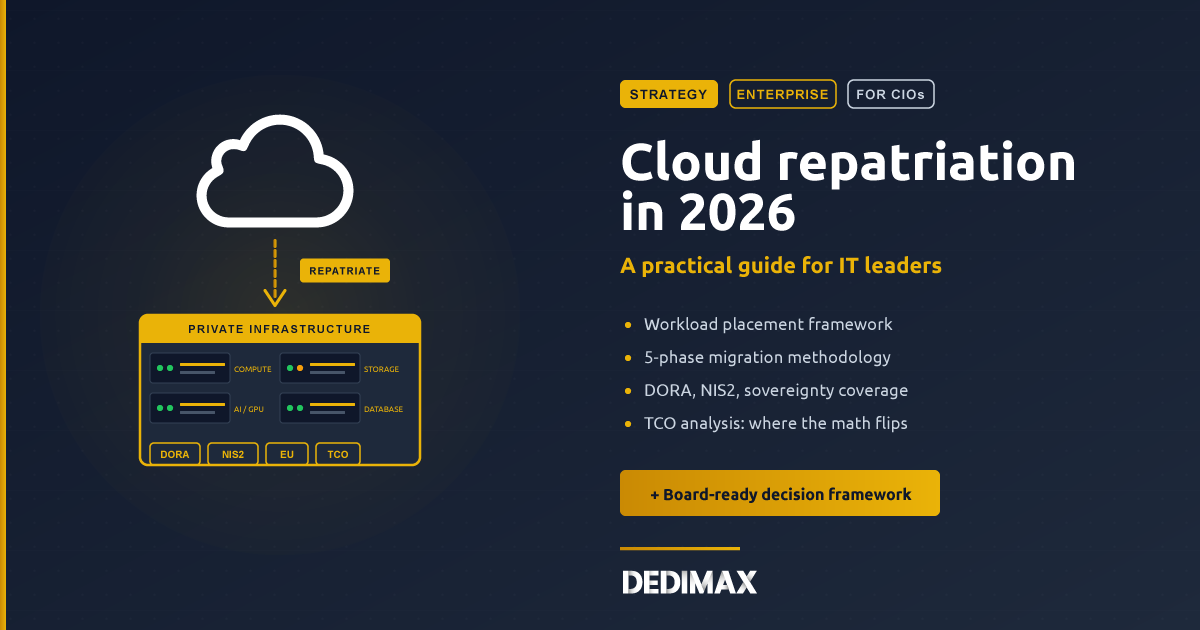
A well-run repatriation project follows a repeatable sequence. Skipping steps is how projects end up over budget, over schedule, or with degraded reliability.
Phase 1, Audit. Pull actual utilization and cost data by workload for the trailing 12 months. Don't rely on annual cloud bills, break costs down to the workload level. Identify which workloads are candidates based on the framework above.
Phase 2, TCO modeling. For each candidate workload, build a three-year TCO comparison. Include hardware amortization or lease costs, colocation or provider fees, networking, staff time, and migration costs. Compare against the actual cloud cost for the same workload, not the projected cloud cost. This is the model your CFO will use to sign off.
Phase 3, Target architecture design. Decide what "private" means for each workload. Options include:
Most organizations find that dedicated hosting delivers the best economics for the majority of repatriated workloads. It removes the elasticity premium of public cloud without the operational overhead of running your own facility.
Phase 4, Migration. Move workloads in waves. Start with lower-risk, lower-visibility candidates to build organizational muscle. Keep the old environment running in parallel until you've validated the new one under real load. Plan for egress fees when moving large datasets. Stage large transfers, compress data before transfer, and negotiate egress discounts with your current provider for planned exits.
Phase 5, Validation and optimization. Run in parallel for at least 30 days after cutover. Compare performance, reliability, and cost against the model you built in Phase 2. Address any gaps before decommissioning the cloud environment. Document the outcome, this becomes the reference for future placement decisions.
The regulatory environment has moved from advisory to operational. Three frameworks in particular are shaping infrastructure decisions in 2026.
DORA (Digital Operational Resilience Act). Enforceable across the EU for financial institutions since January 2025. DORA requires documented resilience testing, defined exit strategies for cloud services, and evidence of control over critical infrastructure. Even if you're staying with your current cloud provider, DORA requires you to demonstrate that you could exit if needed. Many organizations are running repatriation of a subset of workloads specifically to satisfy this requirement.
NIS2 Directive. Transposed into national law across EU member states in late 2024. Requires organizations in critical and essential sectors to assess and manage supply chain cybersecurity risk, including cloud providers. Creates formal obligations around concentration risk. If your entire infrastructure depends on one hyperscaler, you'll need to document that risk and how you plan to mitigate it.
Data residency requirements. GDPR remains the baseline in the EU, but sector-specific rules and national laws add layers. Healthcare data in France (HDS certification), financial data in Germany (BaFin requirements), and public sector data in most EU countries have specific residency and access control expectations that public cloud providers can meet but with additional complexity and often additional cost.
For CIOs in regulated sectors, this creates a clean argument for hybrid architectures: keep the workloads where public cloud economics work, move the regulated workloads to infrastructure where the compliance story is simpler and cheaper to prove.
Public cloud pricing was built for elasticity. You pay a premium for the ability to spin resources up and down instantly. For workloads that actually need that elasticity, it's excellent value. For workloads that don't, it's expensive flexibility you never use.
Broadcom's internal analysis found that modern private cloud delivers 40-50% lower total cost of ownership for steady-state workloads compared to public cloud. Their move of critical workloads off public cloud database-as-a-service saved over 10 million dollars in a single case. That's a large enterprise example, but the pattern scales down. Small and mid-sized organizations with consistent workloads often see 30-60% cost reductions on repatriated components.
Where the TCO math flips depends on utilization and workload characteristics. As a rough guide:
The other side of the equation is the cost of running private infrastructure. Modern dedicated hosting has largely eliminated the traditional friction: provisioning happens in minutes, hardware is managed by the provider, and pricing is predictable. Colocation and on-premises still require operational maturity and capex, but for many organizations, a hosting provider handles the heavy lifting.
Repatriation projects fail in predictable ways. Being aware of the common failure modes lets you plan around them.
Underestimating egress fees. Moving many terabytes of data out of a hyperscaler generates significant egress charges. Budget for it explicitly. Stage the migration in phases, negotiate discounts for planned exits, and compress data before transfer where possible.
Cloud-native lock-in. Workloads that rely on proprietary cloud services (serverless functions, managed databases, event processing pipelines using cloud-specific APIs) can't be repatriated without rewriting. Audit your workloads for cloud-native dependencies early. Some will need to be replaced with portable equivalents before repatriation is even possible.
Skills gap. Teams that grew up on managed cloud services often lack experience operating physical or dedicated infrastructure. Plan for training, partner support, or managed services during the transition. This is where a hosting provider with strong operational support adds meaningful value.
Sizing errors. Cloud abstracts sizing behind pay-as-you-go pricing. When you move to fixed infrastructure, you need to right-size the target environment. Under-sizing causes performance regressions. Over-sizing wipes out the cost savings. Baseline actual utilization, run load tests, and model peak demand before committing to specifications.
Cutover disruption. Moving mission-critical workloads without a rollback plan is how repatriation projects end up on the front page for the wrong reasons. Run parallel environments during the transition. Cut over in stages. Have a tested rollback procedure at every step.
Treating repatriation as ideology. The organizations that get repatriation right treat it as a workload-level decision, not an all-or-nothing move. Some workloads will always belong in the public cloud. Making that call project by project is what separates the successful repatriations from the ones that end up more expensive than the original cloud bill.
For most organizations, the practical answer to "how do we repatriate?" isn't building a data center. It's working with a hosting provider that offers dedicated servers, private cloud, or colocation, without the capex and operational burden of running your own facility.
The value of a hosting provider in a repatriation project comes from three places:
Dedimax offers dedicated servers, VPS, and Cloud servers across 120+ locations, with unlimited bandwidth included on all plans. For European organizations, having infrastructure in EU jurisdictions with clear data residency answers has become a compliance advantage. For AI-heavy workloads, our dedicated GPU infrastructure is often more cost-effective than sustained cloud GPU usage.
The specific fit depends on your workload profile. For CIOs at the evaluation stage, the right first move is running the audit and TCO analysis on your current cloud estate. That data drives every subsequent decision. Once you know which workloads have a strong repatriation case, choosing the target infrastructure is a straightforward next step.
Cloud repatriation in 2026 isn't about rejecting cloud. It's about matching workloads to the infrastructure that actually serves them best. For the workloads where public cloud economics no longer make sense, and for the compliance requirements that public cloud can't easily satisfy, private infrastructure is a mature, well-understood alternative. The organizations that are moving carefully, workload by workload, with a data-driven placement framework, are the ones capturing the benefits without the risks.
Take control of your dedicated server (settings, data ...) without any limits in apps usage.
What are you waiting for ?
We’re waiting for you on our blog. New guides and tutorials published regularly (sysadmin, gaming, devops...) !
Let me check